How Application Temperature Affects Thermal Label Adhesion

How Application Temperature Affects Thermal Label Adhesion

A thermal label rated for service at −40°C can still peel when first applied to a cold carton. The adhesive may tolerate freezing after a bond has developed but need a warmer surface to form that bond. For buyers investigating cold-weather failures, the starting point is to separate application temperature from service temperature, then test the actual packaging and process.
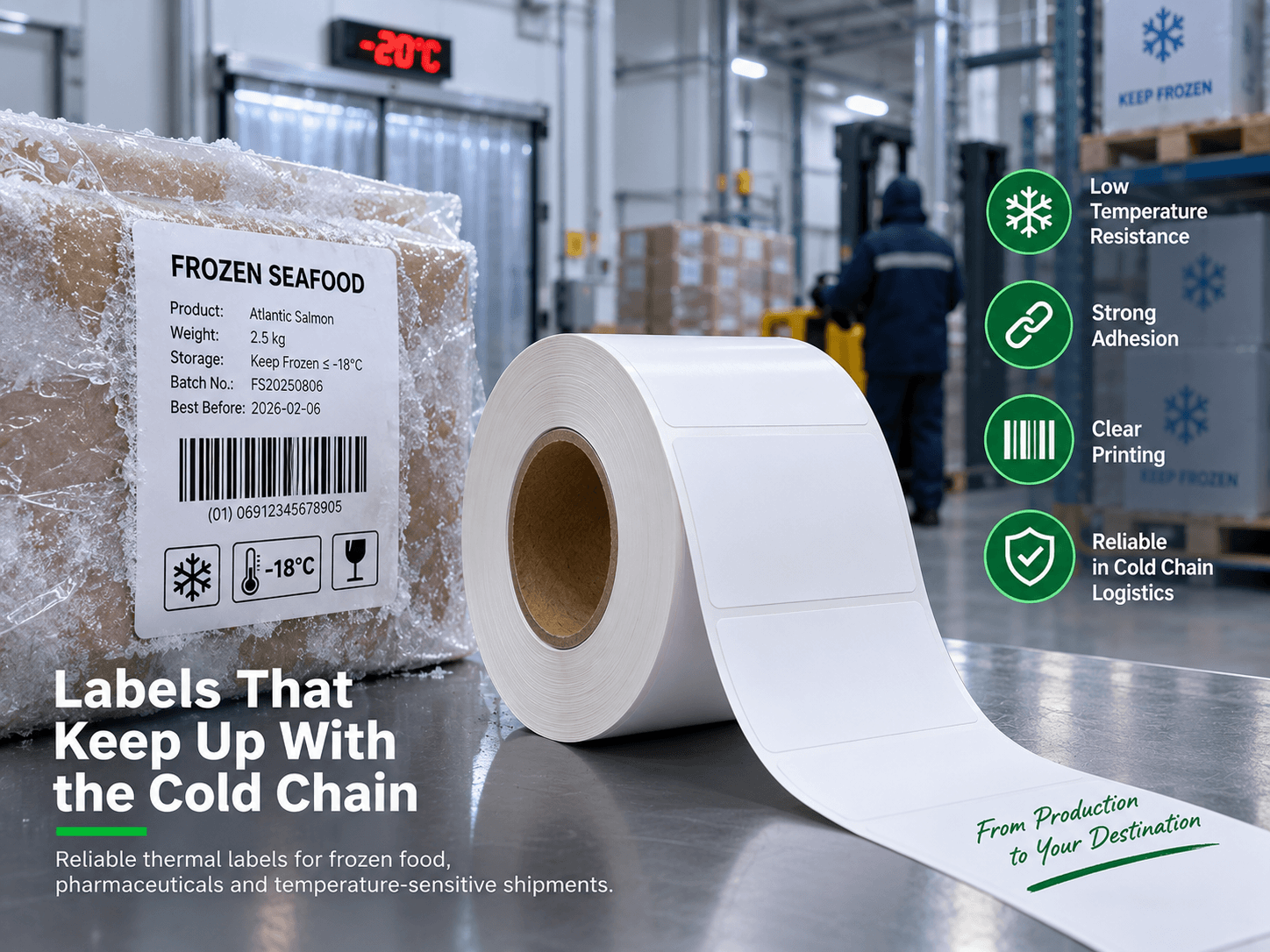
Illustration of a thermal label roll beside a frost-covered seafood carton in a cold store displaying −20°C.
Illustrative cold-chain scene. Freezer service capability does not establish suitability for application to a cold, wet or frosted surface.

Read the two temperature specifications separately

Minimum application temperature is the lowest recommended temperature for applying the label under the supplier’s stated conditions. Service temperature is the range the applied label is intended to tolerate after correct application and any required bond-development period.
As a product-specific example, Zebra’s US Z-Essentials 500D specification lists a minimum application temperature of 4°C and a service range of −40°C to 60°C. Those figures illustrate the distinction; they are not specifications for other thermal labels or for HY-paper materials. Confirm the current datasheet for the exact construction being purchased.
Do not select a material from its lowest service-temperature number alone. Ask about application conditions, any waiting period before cold storage, and the complete construction. Adhesion and printed-image readability are separate performance checks.

Understand what changes at low temperature

Pressure-sensitive adhesive needs close contact with the substrate to form a useful bond. This is often called wet-out. Many adhesives become firmer and less tacky as temperature falls, making that contact harder to establish.
Rough corrugated board can limit contact, but a smooth surface is not automatically easy to label. Plastic type, surface energy, coatings and contamination also matter. Polyethylene and polypropylene, for example, can require adhesive selection that accounts for their low surface energy.

Measure the packaging and check for moisture

A warehouse air reading does not establish carton temperature. Packaging unloaded from a refrigerated vehicle or taken from a cold room may remain colder than the surrounding air. Measure the substrate at the point of labelling and record the label roll’s temperature and storage history too.
Condensation may form when a cold surface enters warmer humid air. Water or frost can interfere with adhesive contact. Test cold dry packaging separately from cold damp packaging; a low-temperature adhesive is not automatically suitable for wet or frosted surfaces. Discuss drying, a different application point, or a construction intended for the actual moisture conditions.
Include colder-month conditions in approval testing, even if initial trials take place in warmer months. Record temperature and humidity rather than using the season as a proxy. This also makes results easier to compare across sites and countries.
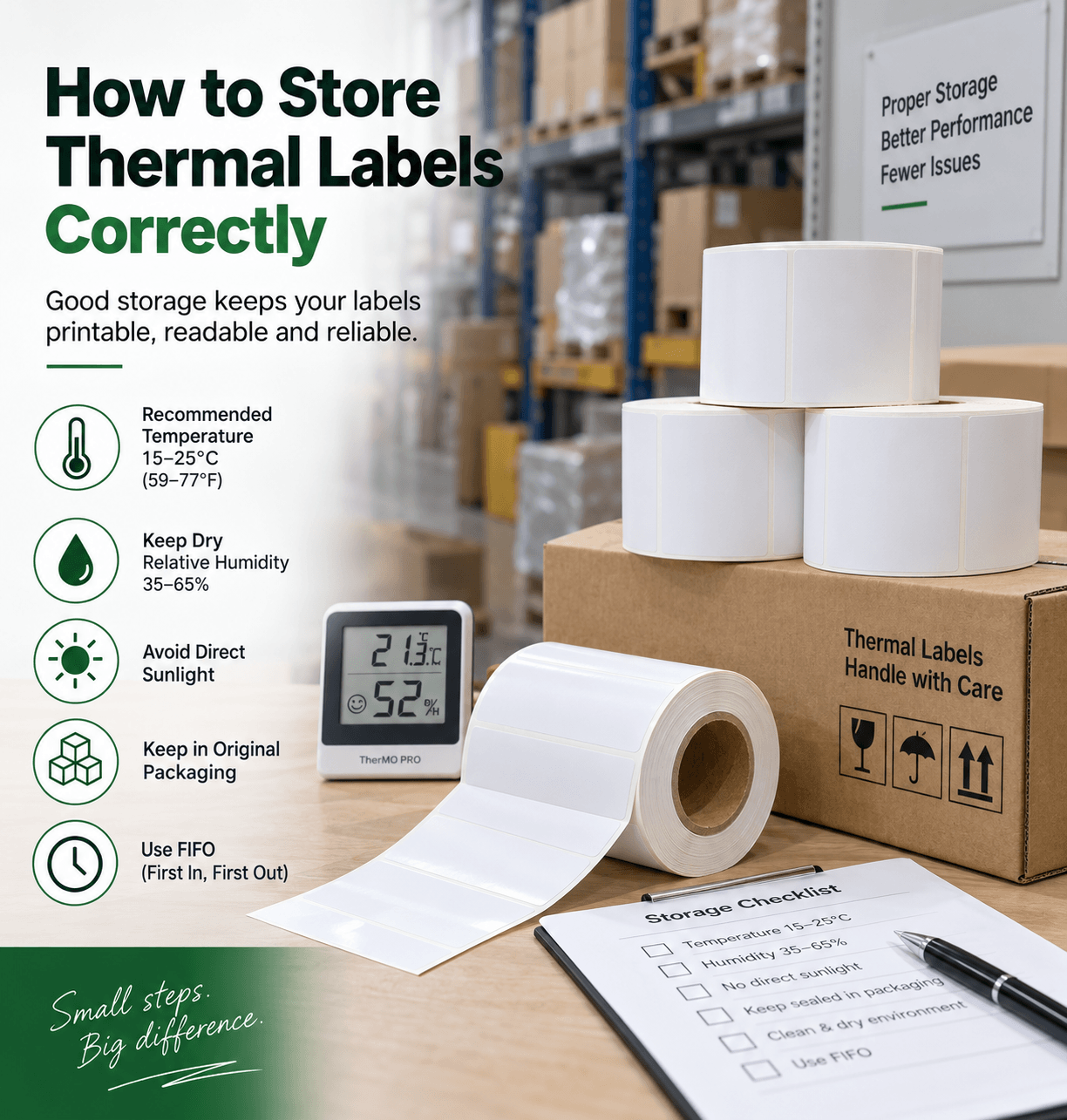
Thermal label rolls with a temperature and humidity monitor and storage guidance covering sunlight, original packaging and first-in, first-out stock rotation.
Illustrative storage guidance. Use the exact material supplier’s specified temperature, humidity and shelf life; the pictured ranges are not universal limits.

Separate application pressure from bond-development time

A hand-applied sample may receive more pressure and more even contact than a label on a fast automatic line. If manual application succeeds but production fails, inspect applicator pressure, roller condition, speed, alignment and contact across the label.
Application contact time is the time spent pressing the label onto the surface. Dwell time here means the elapsed time after application before testing or exposure to the next process step. They are different variables. Ask the material supplier whether the construction needs a specified interval before entering cold storage, and reproduce the real interval during testing.
General pressure-sensitive adhesive guidance explains how pressure, time and temperature affect contact. It does not establish a universal waiting period for every label adhesive.

Run a controlled comparison before changing material

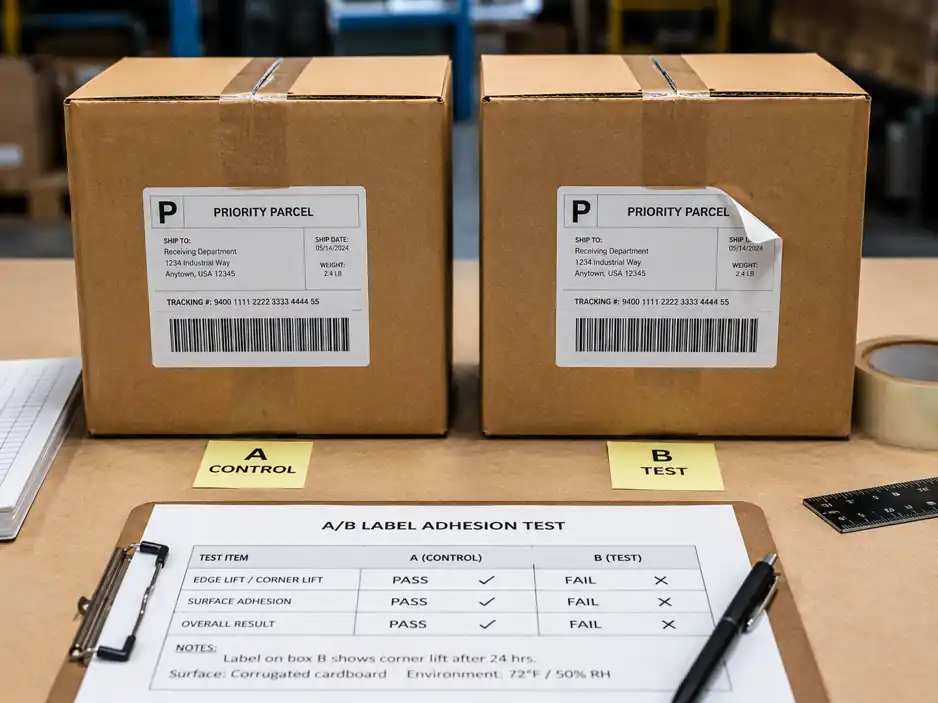
Compare the current material with a proposed alternative on packaging from the same batch. Apply both at a normal reference temperature and at the actual low application temperature. If condensation occurs in production, add a separate condition that reproduces it. Use multiple samples per condition rather than judging a single label.
Keep label size, application method, pressure and handling consistent. Record material and packaging batch references, substrate and roll temperatures, surface moisture, time before cold storage, and inspection times. Check immediate hold, edge lift, movement and performance after realistic storage and handling. Also scan the printed label after exposure.
Define success before testing. For a permanent shipping label, reliable attachment through the required journey is the priority. Fibre tear during removal can be recorded, but it is not a universal pass criterion. For a removable label, evaluate attachment during use and clean removal after the required dwell and temperature exposure. Record residue and surface damage separately.
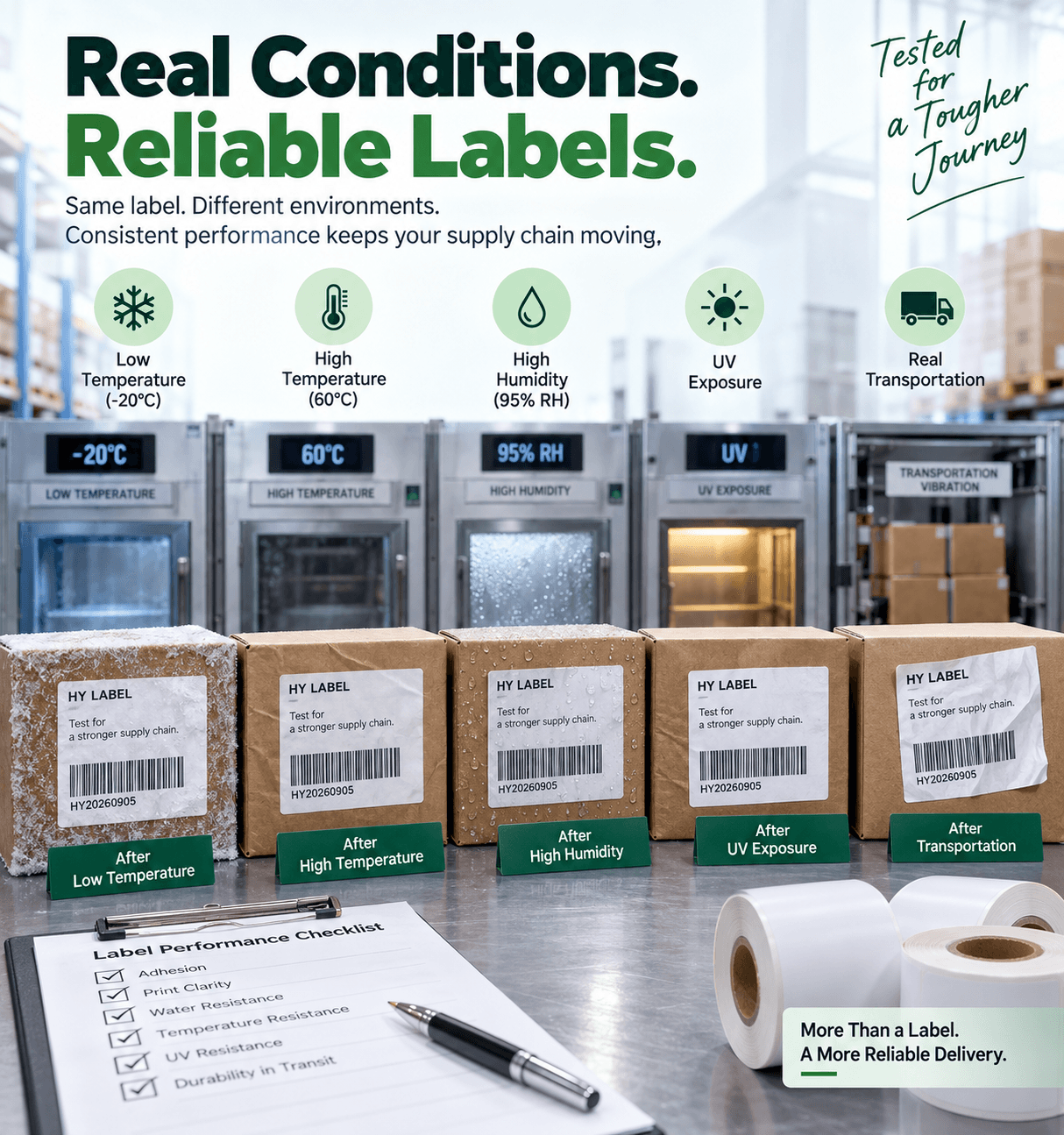
Illustration of labelled cartons under five test conditions: −20°C, 60°C, 95% relative humidity, UV exposure and transportation vibration.
Illustration of possible test conditions, not a record of completed HY-paper tests or verified results. Choose exposure levels and duration for the actual application.

Use failure patterns to narrow the investigation

  • Works after the carton warms up: investigate application temperature while also checking whether surface moisture changed.
  • Fails mainly on damp packaging: investigate moisture tolerance and the application point.
  • Sticks initially but fails in cold storage: check the service range, bond-development interval and complete label construction.
  • Works on one carton batch only: check substrate coatings, texture and contamination as well as temperature.
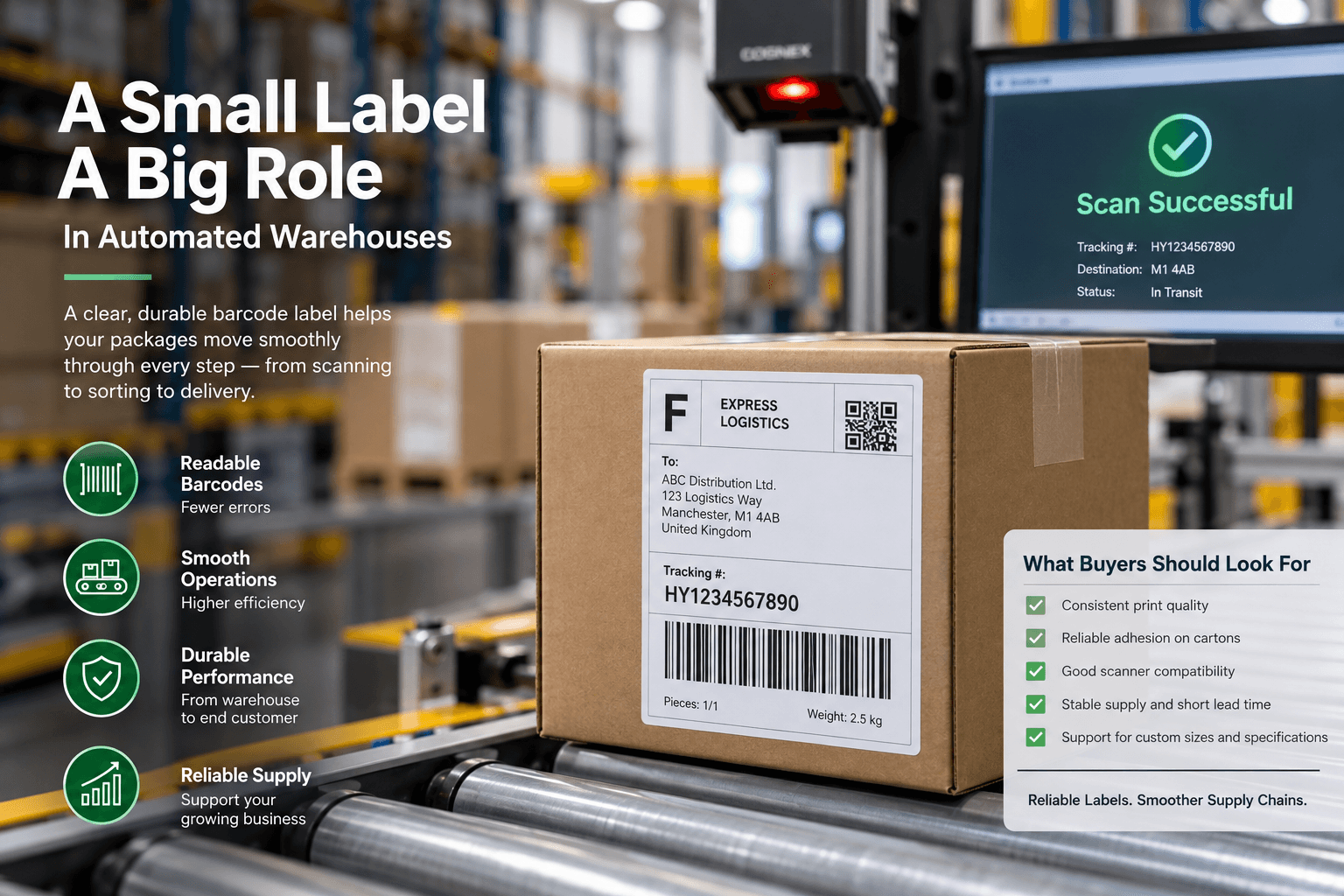
Illustration of a labelled carton passing beneath a fixed barcode scanner on a warehouse conveyor, with a successful scan shown on screen.
Illustration of an automated warehouse workflow. Confirm adhesion and barcode readability in the actual process.

Put measurable requirements on the order

Use a defined application profile instead of “freezer label” or “strong glue”. The following is an illustrative requirement, not a claim that a particular material will pass:

  • Application surface temperature: as low as 0°C.
  • Expected service range: −20°C to +40°C.
  • Substrate: recycled corrugated carton.
  • Method: automatic print-and-apply; possible condensation.
  • Bond requirement: permanent.
  • Minimum time before cold storage and required label life:supplied by the buyer.

Also provide label dimensions, DT or TT print method, printer model, line speed and a packaging sample where possible. Agree the selected material reference, storage instructions and sample acceptance criteria before production. If the actual process falls outside the stated conditions, retest rather than relying on the original approval.

Frequently Asked Questions

Does permanent adhesive mean freezer-compatible?

No. It describes the intended bond type. Both application and service conditions must match the selected construction.

Do all cold-chain labels need freezer-grade adhesive?

No. A label applied in warmer conditions may be suitable for later cold storage if its service rating and required bond-development conditions cover the process. Low-temperature application requires separate confirmation.

Should I choose the lowest temperature rating available?

Choose a construction supported by your actual requirements and sample results. A more extreme rating does not by itself resolve moisture, substrate or applicator problems.


Discuss your application conditions

If labels are lifting, send HY-paper the substrate type, measured application temperature, storage conditions and photos of the failure. Include whether the surface is damp and how soon the package enters cold storage. This gives us a clearer basis for discussing material options and a relevant sample trial.
Shipping_Label_Adhesive_Corrugated_Boxes

Shipping Label Adhesive for Corrugated Boxes: 7 Factors Buyers Should Check

For logistics procurement teams and label distributors, a shipping label that prints perfectly but starts lifting from the carton is not just an application problem—it is a specification and supplier-selection problem.

When this happens, many buyers immediately assume that the adhesive is not strong enough. Sometimes that is correct, but label adhesion to corrugated boxes depends on more than adhesive strength. The result is influenced by carton surface, adhesive chemistry, application temperature, surface cleanliness, application pressure, and time.

That is why the same shipping label can stick perfectly to one carton and peel from another. Before changing suppliers or simply ordering a stronger adhesive, buyers should identify which application variable changed and translate that finding into a clearer adhesive specification for the next sample or bulk order.

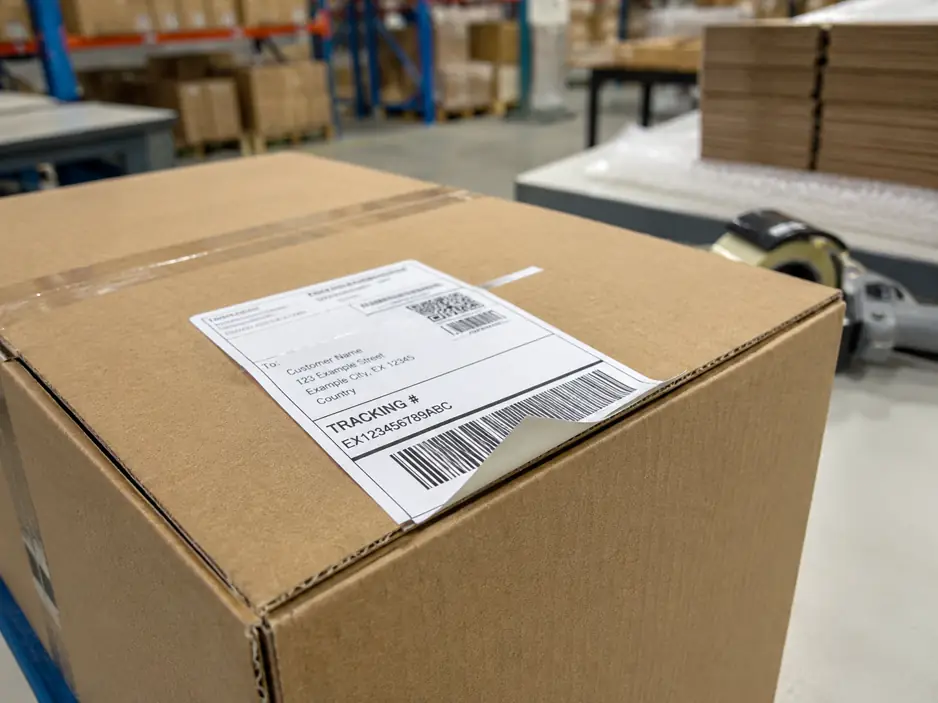
Shipping label edge lifting and peeling off from a corrugated cardboard box surface.

1. Corrugated Surface Is a Purchasing Variable, Not Just a Packaging Detail

Pressure-sensitive adhesive works best when it can make sufficient contact with the substrate. Corrugated cardboard may look flat from a distance, but its outer liner can be rough, porous, heavily textured, recycled, coated, or dusty.

On a rough surface, only part of the adhesive layer may initially contact the carton. The microscopic high points touch first while low areas remain separated from the adhesive. This is why adhesive systems designed for rough surfaces often require stronger initial tack or a construction designed to achieve better surface contact.

2. Recycled Corrugated Can Change Adhesive Requirements

This is particularly important as more logistics operations use recycled-content boxes. Recycled corrugated does not necessarily present the same outer surface as virgin-fiber board. Your label specification may not have changed, but your carton supplier may have changed fiber composition, recycled content, surface roughness, coating, or dust level.

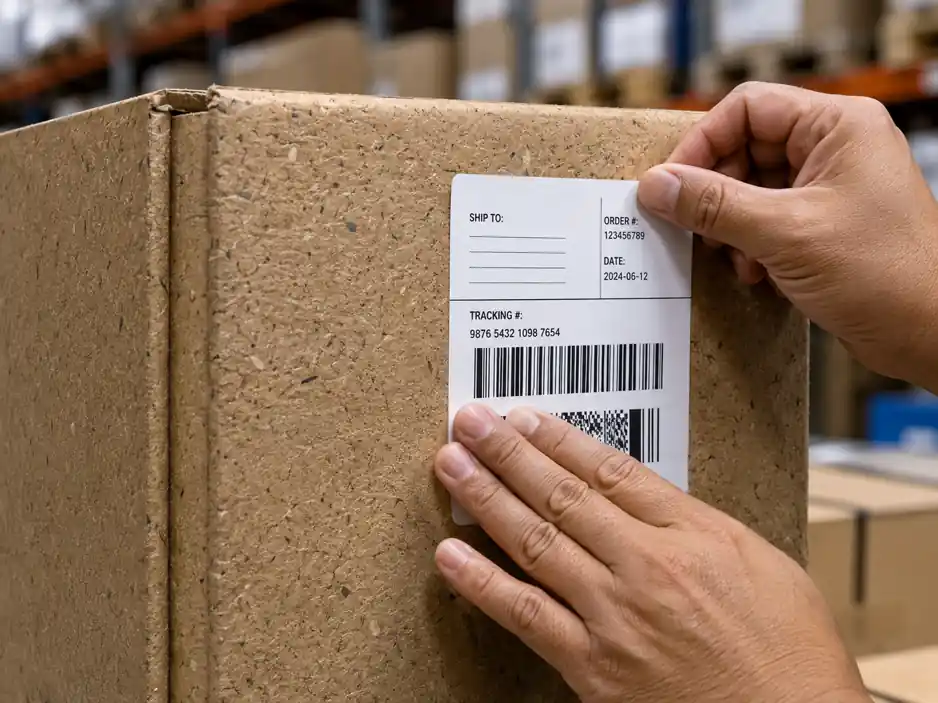
Warehouse operator applying a pressure-sensitive adhesive label onto a corrugated carton.

When adhesion suddenly changes, compare an old approved box and the current box using the same label roll. That simple test can quickly separate a carton-related problem from a label-related problem.

3. Why Permanent Adhesive Is Not a Complete Purchasing Specification

For buyers comparing adhesive constructions, one of the most useful distinctions is initial tack versus ultimate adhesion. Initial tack describes how quickly the adhesive grabs the carton when the label is first applied, while ultimate adhesion describes the strength of the bond after it has had time to develop.

  • Initial Tack: Essential for high-speed logistics operations because cartons enter conveyors or sorting equipment shortly after labeling.
  • Ultimate Adhesion: Ensures long-term holding power across storage and transit lifecycles.

4. Application Temperature Must Be Included in the RFQ

One of the most common specification mistakes is confusing application temperature with service temperature. Application temperature is the temperature of the label and substrate when the label is being applied, whereas service temperature is the range the label can tolerate after a proper bond has already formed.

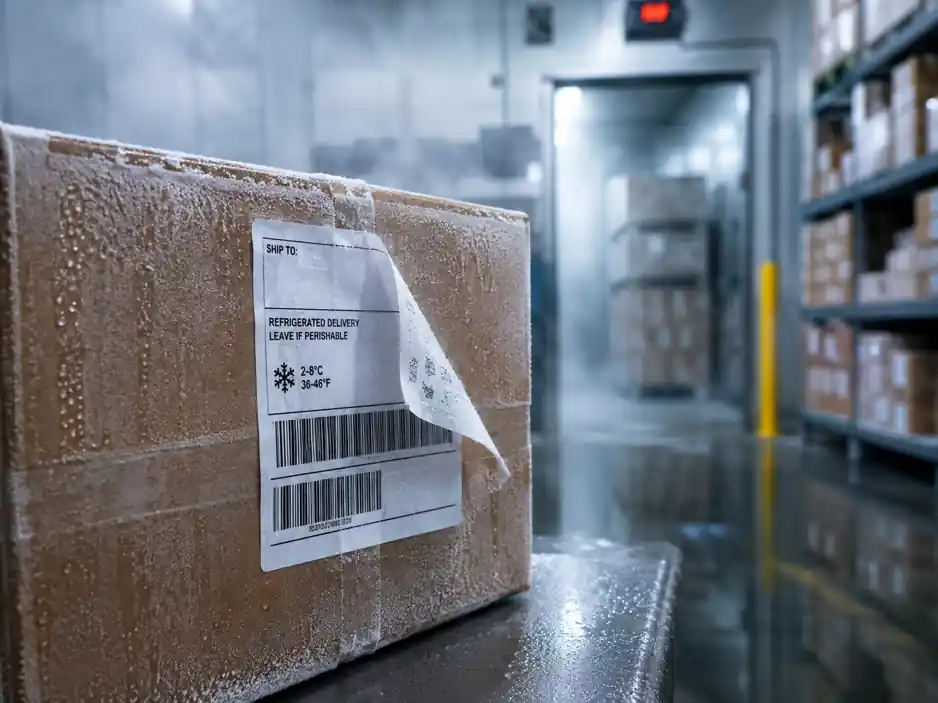
Label peeling off from a cardboard box due to condensation and frost in a cold storage facility.

If the carton is already very cold when labeling occurs, a standard adhesive may not wet out correctly. This is especially important in refrigerated warehouses and cold-chain operations.

5. Warehouse Contamination Can Make a Good Adhesive Look Like a Bad One

Sometimes the adhesive never actually bonds to the corrugated fibers because it bonds to what is sitting on top of them, such as paper dust, warehouse dust, moisture, condensation, oil, or handling contamination.

A useful diagnostic clue is looking at the back of a failed label: if it comes away with visible cardboard fibers attached to the adhesive, the failure mechanism differs from a label that cleans away without fiber tear.

6. Sample Approval Must Reflect the Real Application Method

Most shipping labels use pressure-sensitive adhesive. Applying pressure helps the adhesive spread or wet out across the carton surface, increasing the real contact area. A material may pass a manual sample test because someone carefully presses it onto the box, but fail on the production line because the automatic applicator does not provide equivalent pressure.

7. Placement and Carton Flexing Can Still Cause Edge Lift

Avoid applying shipping labels over a box seam, across a corner, over sealing tape, or onto a folded or deeply textured area. When a carton flexes, a label positioned across an edge is continuously bent, making the label edge a starting point for peeling.

Testing workbench comparing label adhesion performance on corrugated boxes with a test log sheet.

Frequently Asked Questions

Why do shipping labels peel off cardboard boxes?

Common causes include rough or recycled corrugated surfaces, insufficient initial tack, low application temperature, dust or moisture, inadequate application pressure, and poor label placement.

What adhesive works best on recycled corrugated boxes?

High-tack permanent adhesives and certain hot-melt constructions are often used for difficult recycled corrugated surfaces, though the material should still be tested on the actual carton.

Is a permanent adhesive always enough for shipping labels?

No. Permanent describes the intended bond type, not its performance on every substrate. Rough recycled corrugated and cold surfaces may require specialized high-tack constructions.

Why does a label stick at room temperature but fall off in a cold warehouse?

The adhesive may have been applied below its minimum application temperature, as application temperature and service temperature are different specifications.


Selecting a Shipping-Label Adhesive for Corrugated Cartons?

Share the carton type, application temperature, application method and required label life so the construction can be evaluated and sample-tested before bulk approval.

The Ultimate Guide to Freezer-Safe Labels for Organic Food Packaging

Choosing excellent freezer-safe food labels is essential for ensuring stability and performance in long-term cold storage. From cold-resistant adhesives to moisture-proof face materials, this guide explores the technical standards and critical factors for organic food packaging in extreme low-temperature environments.

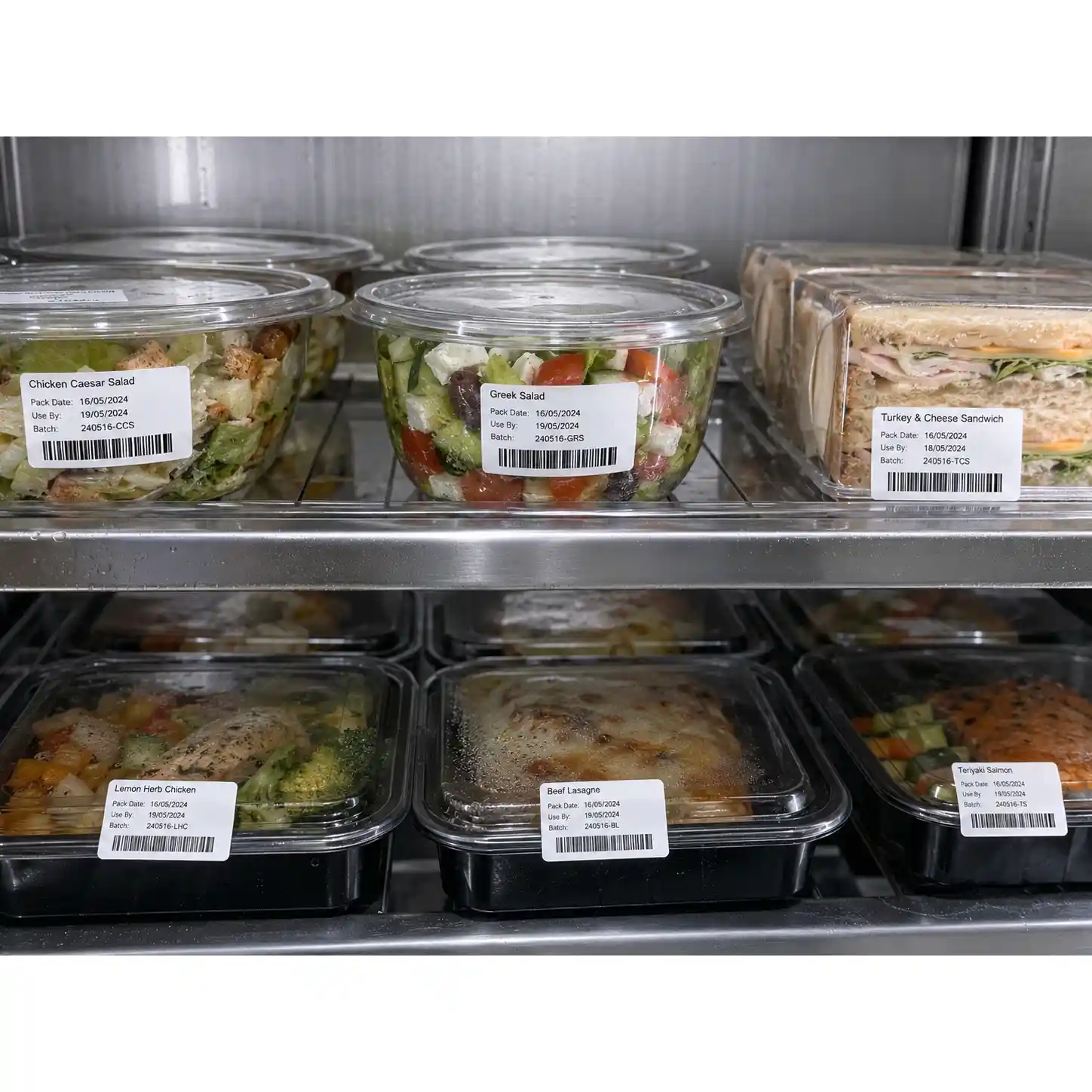
HY Paper frozen food packaging thermal label

Key Features of Premium Freezer Safe Food Labels for Long-Term Frozen Storage

Excellent freezer safe food labels are carefully designed for their stability and effectiveness at extremely cold frozen food storage, providing good adhesion and clarity for several months or even years in either commercial cold rooms or home freezers. The unique cold resistance properties of these special food labels are achieved by the use of customized cold resistant adhesives which ensure steady stickiness and prevent any lifting, bubbling and complete separation during long-term static storage and changing temperatures in freezers which can be damaging for ordinary labels.

The surface of high-quality freezer safe food labels is made from premium materials which provide exceptional frost and moisture resistance to prevent blurring of prints, damaging of texture and destruction of standard food labels due to heavy condensation and frost in freezers. Moreover, environmentally friendly and fade resistant printing inks are used for production of such professional food labels that allow to keep all important information about products, including text, brand name, ingredients and certifications without smudging, fading and peeling. Due to flexible yet durable materials, these labels fit well both flat and curved surfaces of food packages, having great tensile strength and preventing damage.

Common Causes of Cold Chain Label Adhesive Failure in Low-Temperature Environments

The problem of failure of the label adhesive during cold chain logistics and prolonged low temperature storage is due to imperfections and poor compatibility of materials used in manufacturing of the packaging by organic food companies. The conventional label adhesive rapidly loses its initial viscosity under conditions of constant sub-zero temperature due to the fact that cold air hardens its internal adhesive layer and totally eliminates the adhesive forces between labels and various food packaging materials.

HY Paper thermal label for cold chain logistics

Constant temperature variations in central cold rooms, refrigerated transportation vehicles and frozen display cabinets create condensation on the outside packaging surface, forming a layer of moisture that gradually creates an invisible barrier between the label and the package leading to partial or total separation. Most conventional food labels are made of inexpensive water-based adhesive unsuitable for the rigorous conditions of cold chain operation and unable to withstand long-term frost abrasion leading to gradual peeling off the labels.

Professional Solutions to Avoid Cold Chain Label Adhesive Peeling and Falling Off

Use of quality materials and standardized processes for labeling is able to solve repeatedly occurred cold chain label adhesive peeling and dropping problem for professional organic food packaging. By adopting high-quality and specially designed low-temperature solvent-based adhesives used for bonding only in freezing conditions, the quality and duration of bonding will be guaranteed due to the fact that special composition of this kind of adhesive allows it to resist the influence of freezing and to keep its flexible properties while being exposed to freezing temperatures and frequent changes in temperatures during cold chain logistics.

Waterproof label backing materials improve the durability of labels, as they do not allow label edges to curl up or shrink when exposed to multiple expansion and contraction caused by frosting. Adequate pre-treatment of packaging materials helps to create dry and clean surface for bonding, which increases the quality and durability of labels. The brand may choose customized thickness of labels and strength of adhesion depending on materials used for packaging (including plastic films, kraft paper boxes and composite packaging). Standardized bonding conditions for labels in room temperature also guarantee perfect sticking effect.

Core Standards for Qualified Organic Food Packaging Labels in the Freezer Industry

Freezer-appropriate organic food packaging labels have to conform to rigorous safety and environmental industry standards, as well as demonstrate stable adaptive properties at extremely low-temperature operation. All materials used for manufacturing label base and printing ink should be in accordance with premium safety requirements concerning the production of food-grade products without any harmful or toxic chemical components, which might be dissolved and lead to pollution of natural, organic foods in conditions of long-term storage and freezing and thawing cycles.

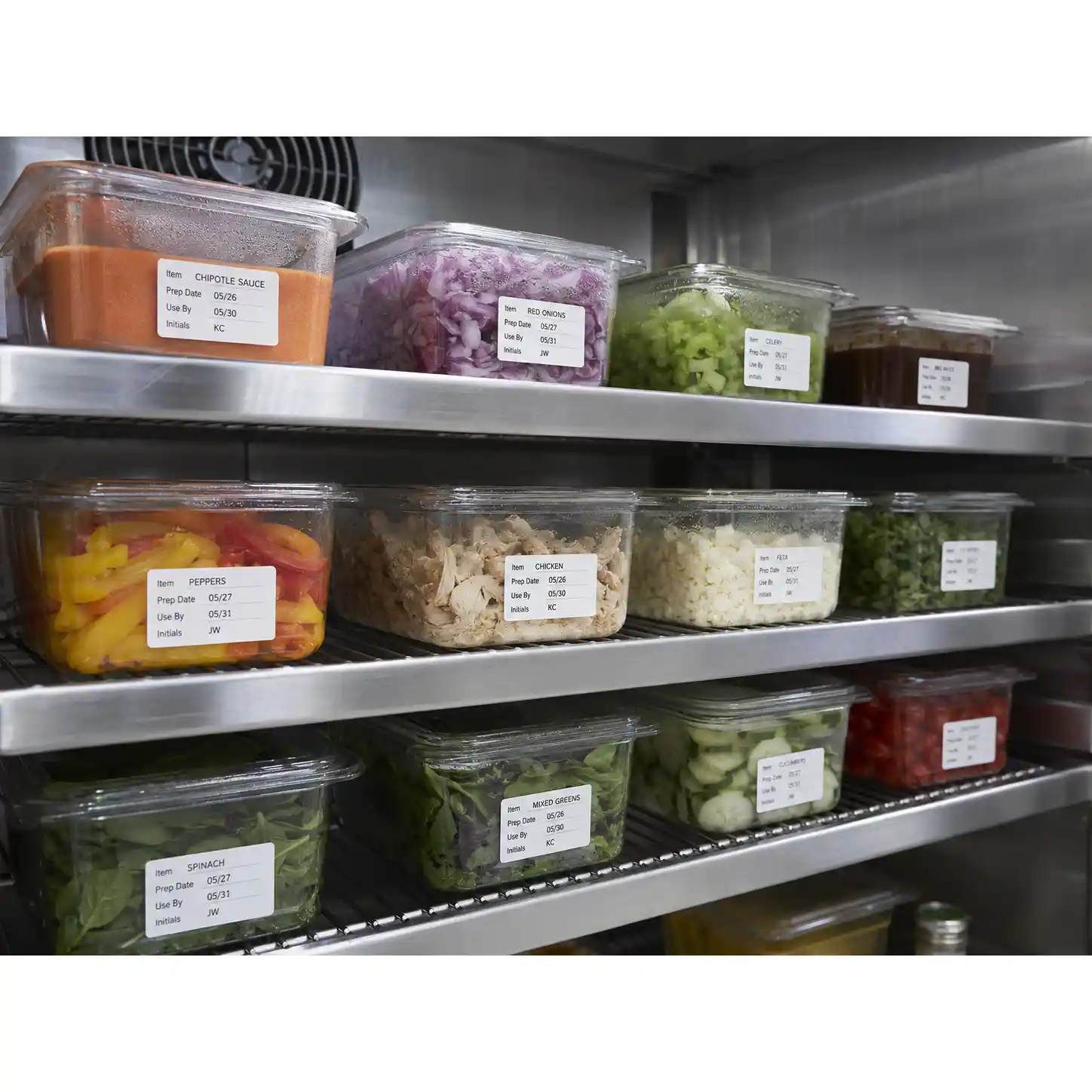
HY Paper food label for jars bottles and boxes

Certified organic packaging labels should demonstrate durable and permanent printing of all essential information about product including its origin, list of ingredients, certification, date of production and shelf life data without any signs of fading, blurring or smearing in conditions of constant frosting and low-temperature erosion. Freezer labels for organic products have to pass third-party freezing resistance tests for proving their stable physical characteristics without any cracking, shrinking or peeling in sub-zero conditions of storage. Biodegradability and recyclability of eco-friendly material is a key requirement of the industry and perfectly fits into the sustainable and green development philosophy of the worldwide organic food industry, and standardization of size and safe adhesive provide full compliance with organic food packaging regulations.

How to Select Durable Freezer-Safe Labels for Organic Food Cold Chain Transportation

Choosing high-quality and highly durable freezer-safe labels to be used for the cold chain transport of organic foods needs a thorough investigation of environmental suitability, safety accreditation and usability of labels for long-term logistics and frozen storage. Consumers need to choose those labels that come with customized professional cold-resistant adhesive systems, which allow the labels to have a constant stable bonding strength in spite of frequent changes in temperatures and months-long freezing.

It is important to check the certification credentials to make sure that all the materials from which the labels are made (base material, adhesive and ink) satisfy food grade and environmental safety standards so that they do not affect the purity of the food products and organic certifications. Surface printing quality and functions should be checked in order to be sure that they have high resistance to frosts, moisture and fading, which allows them to be visible at any stages of cold chain transportation, storage and placement on retail shelves. Professional consumers match the specialized label materials with the certain type of packaging, such as plastic films, plastic boxes and coated paper boxes, focusing on their durability and anti-crack properties in order to avoid damages during transportation.


Verify Your Cold Chain Labeling Performance

Testing your label adhesives under real -18°C blast freezing and moisture condensation conditions prevents costly transit peeling. Contact HY Paper’s technical center for customized material testing and free physical samples.