
Direct Thermal vs Thermal Transfer Labels: A Logistics Buyer’s Guide
For procurement teams, distributors and barcode solution providers, the question is not simply whether Direct Thermal or Thermal Transfer is better. The better purchasing question is whether the construction matches the required barcode life, environment and operating workflow.
Start with the application requirement: how long must the barcode remain readable, and what will the label experience before the end of its journey? Direct Thermal (DT) and Thermal Transfer (TT) can both produce high-quality barcode labels. The right choice depends mainly on required label life, environmental exposure, printing volume and operating conditions.
For parcel shipping and short-term fulfillment labels, Direct Thermal is often the simpler option. For long-term warehouse identification or labels exposed to abrasion, chemicals or outdoor conditions, Thermal Transfer is often more suitable. But there are important exceptions.
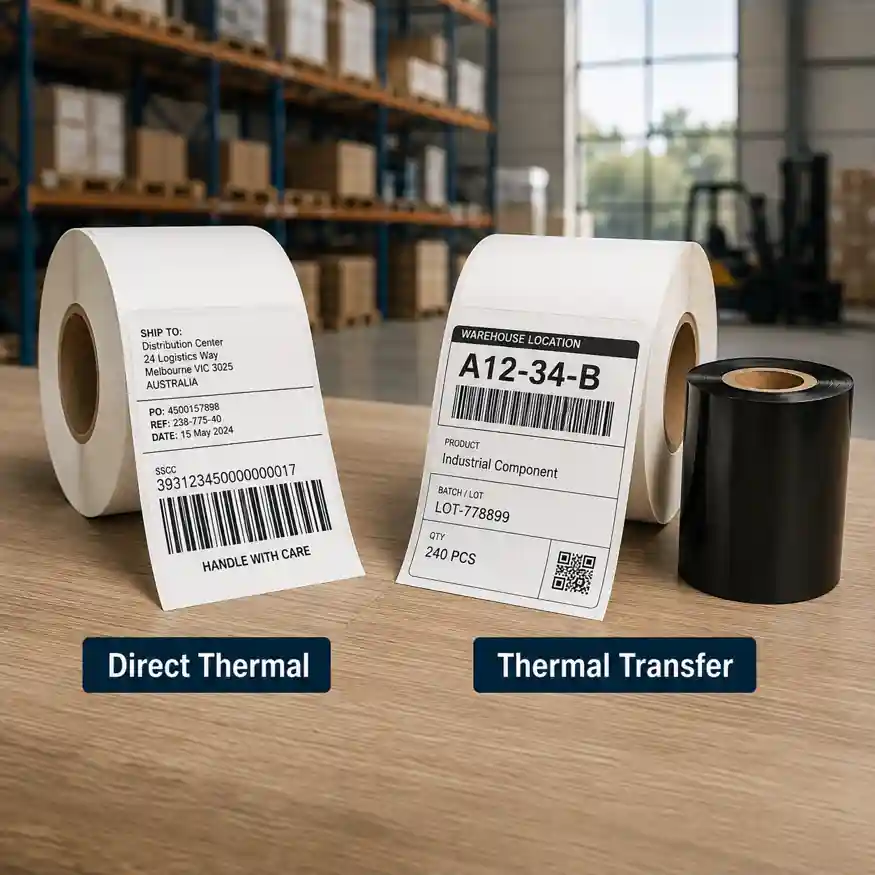
Quick DT vs TT Decision Guide for Buyers
Application and suggested starting points help establish baseline selection criteria before final validation:
- Parcel shipping: Direct Thermal — Short life, no ribbon.
- E-commerce fulfillment: Direct Thermal — High-volume variable printing.
- Temporary picking labels: Direct Thermal — Limited readable-life requirement.
- Long-term rack labels: Thermal Transfer — Long image life.
- Asset identification: Thermal Transfer — Durability.
- Reusable containers: Thermal Transfer — Repeated handling.
- Outdoor storage: Thermal Transfer / durable DT — UV and environment must be tested.
- Cold chain: Depends on construction — Adhesive and facestock matter.
- Chemical exposure: Usually Thermal Transfer — Wider resistance options.
This guide should be treated as a starting point, not a universal specification. Every application should still be tested using the actual printer, substrate and operating environment.
Quick Technical Difference: What Changes for Procurement?
Both technologies use a thermal printhead. The difference is how the image is created. Direct Thermal uses a heat-sensitive coating on the label. Heat from the printhead activates the coating and creates the printed image. No ribbon is required.
Thermal Transfer uses a ribbon. The printhead heats the ribbon and transfers wax, wax/resin or resin material onto the label surface. In simple terms, Direct Thermal uses Label + heat, while Thermal Transfer uses Label + ribbon + heat.
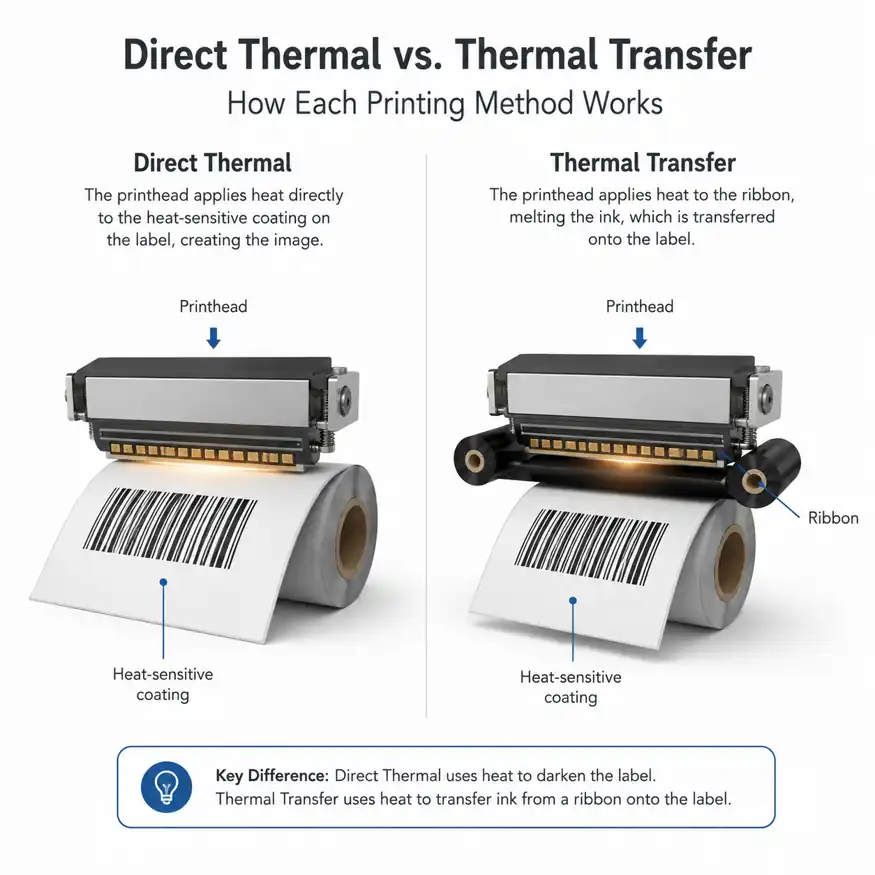
This makes Direct Thermal operationally simpler because there is no ribbon to install, stock or replace. Thermal Transfer, however, provides more combinations of label materials and ribbons, allowing higher resistance to scratching, moisture, chemicals and long-term environmental exposure.
Start With the Specification: How Long Must the Barcode Last?
This is one of the most important questions procurement teams should answer before comparing supplier quotations or approving a material. A shipping label may only need to remain readable for several days or weeks, whereas a warehouse location label may need to remain readable for several years.
Direct Thermal is commonly used for parcel shipping labels, e-commerce fulfillment labels, temporary inventory labels, picking labels, and receipts or tickets. Thermal Transfer is commonly used for warehouse rack identification, long-term inventory labels, asset tracking, reusable containers, outdoor identification, and labels exposed to chemicals or repeated abrasion.
Before asking a supplier whether to use DT or TT, ask whether the barcode needs to last 10 days, 10 months or several years. That answer often determines the starting point.
When Direct Thermal Reduces Operational Complexity
For many logistics applications, Direct Thermal should be evaluated first because it removes one consumable from the printing process: the ribbon. This can simplify daily operation in fulfillment centers and shipping departments where large numbers of variable labels are printed.
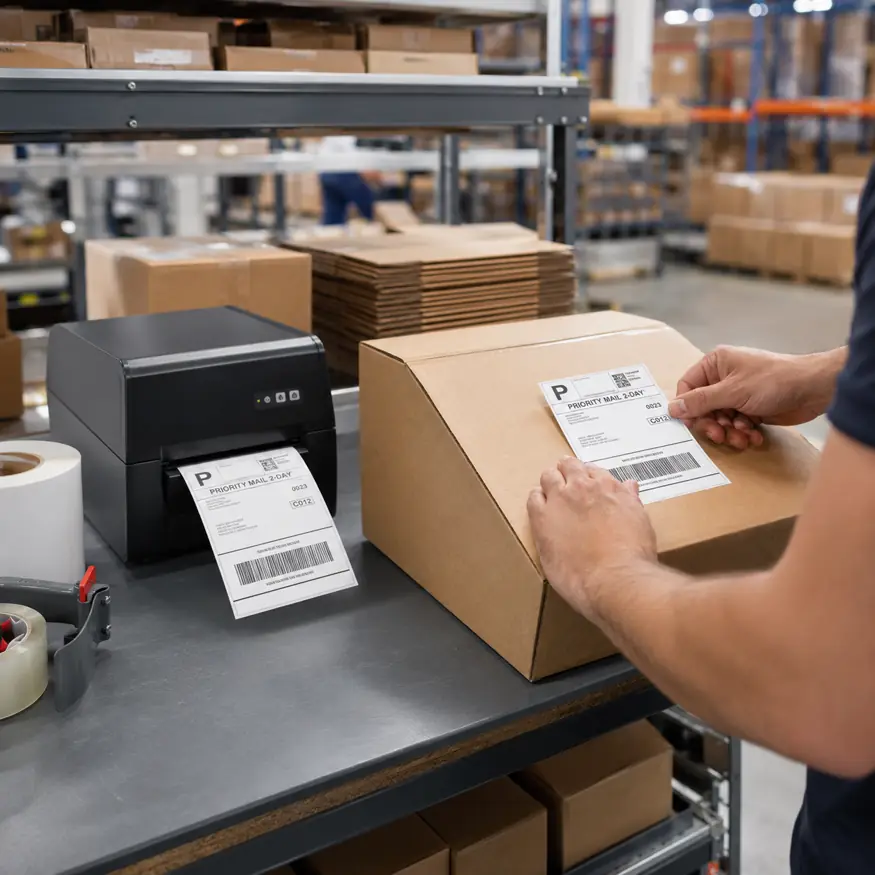
There is no ribbon change, no ribbon inventory and no need to match ribbon length with the label roll. Direct Thermal is therefore particularly attractive for high-volume shipping, short label life and indoor use. A typical 4×6 shipping label is a good example of this operational efficiency.
When Thermal Transfer Justifies the Added Consumable Complexity
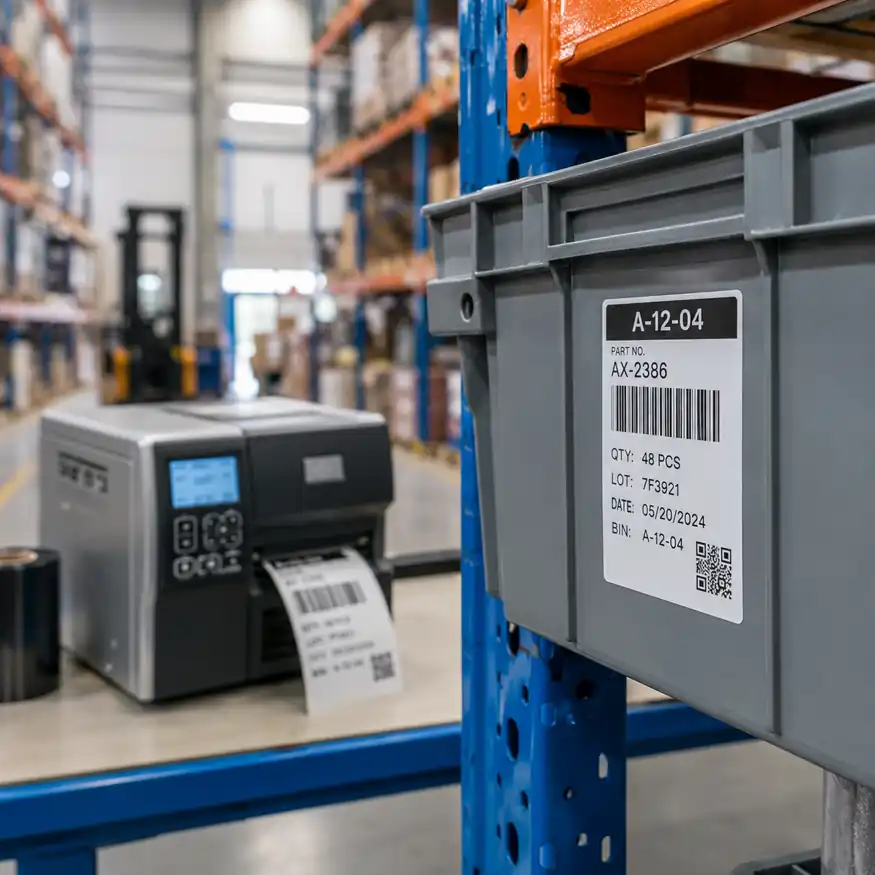
Thermal Transfer becomes more attractive when the printed information itself must survive demanding conditions, such as long-term storage, frequent handling, abrasion, oil or chemical exposure, UV exposure, and outdoor use.
The key advantage is the ability to combine different facestocks with different ribbon chemistries:
- Wax ribbon: Often used with paper where moderate durability is sufficient.
- Wax/Resin ribbon: Provides stronger resistance to scratching and smudging.
- Resin ribbon: Provides substantially greater resistance when used with suitable synthetic materials.
What Buyers Should Compare Beyond DT vs TT
Direct Thermal is often described online as cheap paper for temporary labels, but that description is incomplete. Modern Direct Thermal materials include uncoated paper, top-coated paper, specialty papers, and synthetic Direct Thermal materials. Top-coated materials can provide additional protection against moisture, abrasion and light chemical exposure.
Performance depends on the complete label construction: print technology, facestock, coating, adhesive, and environment. Two products described simply as Direct Thermal labels can use different components and perform very differently.
Do Not Choose Based on International Shipping Alone
A common assumption is that domestic shipping uses DT while international shipping uses TT, but that is too simplistic. Consider a label that travels internationally but reaches the customer within five days and remains indoors, versus a label that never leaves the country but stays on a warehouse rack for five years.
The relevant questions focus on transit duration, sunlight exposure, moisture, physical friction, and chemical contact rather than geography alone.
Cold Chain: DT vs TT Is Only Part of the Decision
Cold-chain buyers often focus immediately on print technology, but a label can have a perfectly readable barcode and still fail if it falls off the package. In refrigerated and frozen logistics, buyers should also specify application temperature, service temperature, surface material, condensation exposure, and required label life.
Both Direct Thermal and Thermal Transfer constructions can be designed for cold environments. Cold chain selection translates into specifying complete application conditions rather than defaulting automatically to Thermal Transfer.
Compare Total Operating Cost, Not Just Price per Roll
Another purchasing mistake is comparing only the price per roll. The actual cost of a labeling system includes label cost, ribbon cost, operator time, ribbon changes, printer downtime, printhead wear, reprints, and failed barcode scans.
Direct Thermal removes ribbon cost and ribbon-change time. Thermal Transfer introduces ribbon cost but may provide stronger durability and reduce direct wear on the printhead because the ribbon separates the printhead from the label surface.
What Procurement Teams Should Include in an RFQ
Before requesting or comparing quotations, provide specific details to ensure suppliers quote against identical application requirements:
- Printer parameters: Printer model and resolution (such as 203 or 300 dpi).
- Physical specs: Label size and application surface.
- Environmental conditions: Required barcode life, indoor or outdoor use, temperature range, and exposure elements.
- Volume and workflow: Approximate printing volume and current ribbon usage.
Frequently Asked Questions
Is Direct Thermal suitable for shipping labels?
Yes. It is widely used for parcel and e-commerce shipping labels where the required image life is relatively short.
Does Thermal Transfer always last longer?
Thermal Transfer generally offers more long-term durability options, but coated and specialty Direct Thermal materials can perform well in more demanding environments than basic Direct Thermal paper.
Which is better for warehouse labels?
Temporary picking and shipping labels often suit Direct Thermal, whereas long-term rack, asset and location labels more often favor Thermal Transfer.
Does Direct Thermal require ribbon?
No. Direct Thermal uses heat-sensitive media and does not require ink, toner or ribbon.
Comparing Thermal Label Samples or Investigating Batch Inconsistency?
Share your printer model, label size, required barcode life, environment and approximate volume to build a clearer RFQ and sample specification.